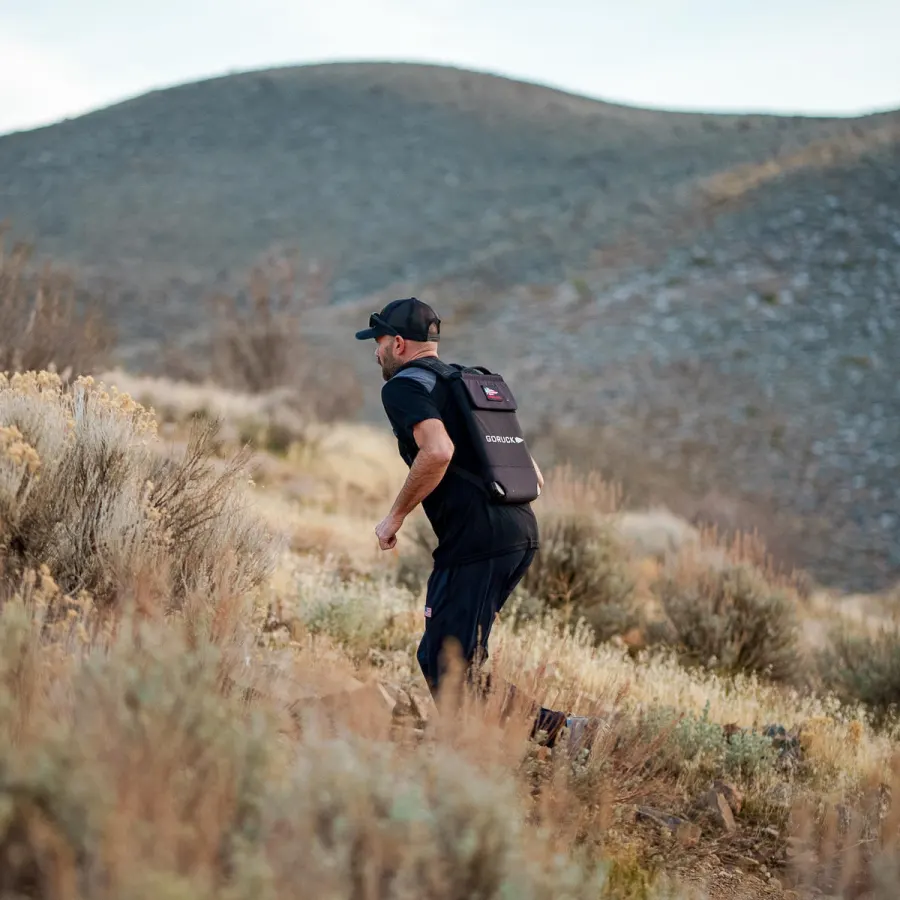
Posture
Your phone is training your posture. Here is what trains it back.
GORUCK's own guide calls it text neck. The correction is not a stretch. It is a counterweight.
You already know the shape. Head in front of the shoulders, chin dropped, upper back rounded over a six inch screen. You have seen a photo of yourself from the side and thought about doing something.
Then you did the thing everyone does. A few shoulder rolls. A doorway stretch. Maybe a week of remembering to sit up straight. It faded by Thursday, because it was always going to.
Here is the part that gets skipped. Posture is not a habit you forgot. It is a rep count. You hold that forward position for hours, most days, for years. Thirty seconds of stretching does not argue with that. Nothing in a normal day argues with that, because almost every load you carry sits in front of you.
Which is the interesting question, and the one GORUCK's own material keeps circling. If the problem is that everything pulls you forward, what pulls the other way?
01 The rep countYour posture is not a habit. It is the position you spent the most hours in.
GORUCK does not treat this as a marketing angle. It is written into the beginner guide on their own site, in the section on why you should get outside at all:
Rucking offers the chance to look away from a screen and maybe fix that "text neck" you're developing. We weren't meant to spend our lives hunched over computers or looking at our phones, breathing recycled air in cloistered environments like lab rats. GORUCK, Get Started Rucking
Their longer piece on the physical benefits of rucking says the same thing in flatter language, and it is worth reading as a mechanism rather than a slogan. Hunching, they write, causes near constant activation of the muscles that run along the spine, and that near constant activation is a key contributor to back pain.
So the muscles are not weak from doing nothing. They are tired from holding one position all day. That distinction matters, because it changes what a fix has to look like. You do not need a reminder. You need a few hours a week where the load points the other way.
Where the load sits, the spine follows
Load in frontThe head travels forward of the vertical line to balance it. Every hour spent here is a rep.
Load behindThe weight pulls the shoulders back and the head stacks over them. Same walk, opposite direction.
Almost everything you carry sits in front of you. A ruck is the exception.
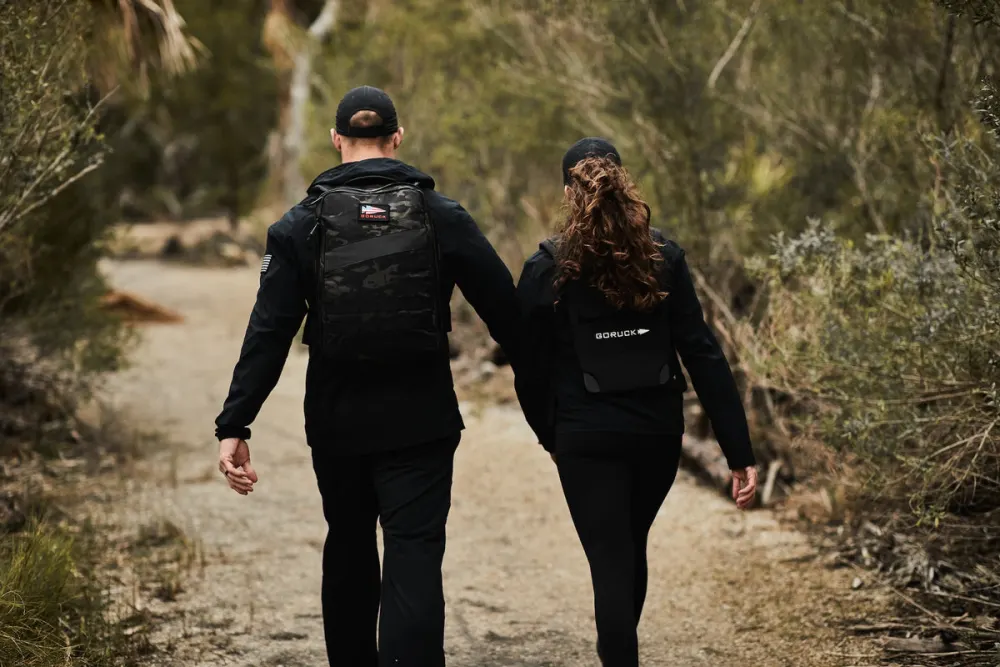
Run through a normal day. The phone is in front. The steering wheel is in front. The keyboard, the mixing bowl, the toddler on your hip, the grocery bag you swing forward as you walk. Your body spends the day balancing weight that lives ahead of your spine, and the only way to balance it is to bring your head and shoulders forward to meet it.
A rucksack is one of the few loads left in modern life that sits on the other side. GORUCK puts the mechanism plainly on their benefits page, and it is a physical claim rather than a wellness one:
Rucking, though, naturally pulls your shoulders back, and as you cinch your rucksack down your shoulders and spine move into their natural north - south alignment. This improves posture and takes strain off of some muscles in your lower back while strengthening your upper back. GORUCK, Physical Benefits of Rucking
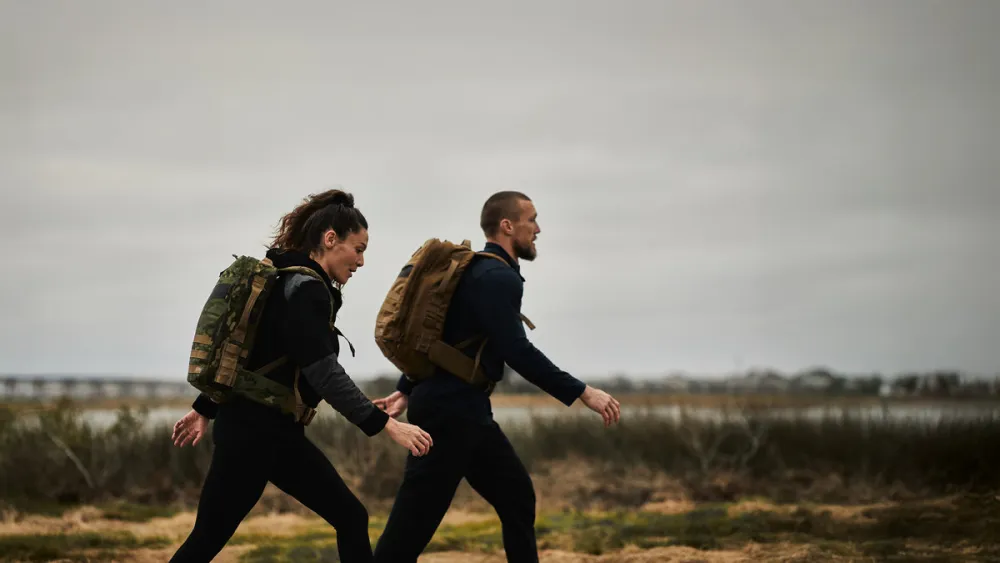
Elsewhere on the site they describe the same effect in one line: the weight of the rucksack pulls your shoulders into proper alignment while moving. Not while you concentrate on it. While moving.
That is the whole difference between a cue and a counterweight. A cue asks you to remember. A counterweight does not care whether you remember, because the physics is doing the work while you walk to the end of the street and back.
Adding weight can let your back muscles rest
This is the claim on GORUCK's benefits page that sounds wrong the first time you read it, and it is the most interesting sentence on their site. Multiple studies, they write, have found that light to moderate loads produce postural changes which actually disengage the muscles along the spine, giving them a chance to rest from the strain caused by poor posture.
Read it twice. The weight is not the punishment. The weight is what finally lets the muscles that have been quietly straining all day stop straining, because the skeleton is stacked the way it is supposed to be stacked and the load is being carried by structure rather than by effort.
That is also why this does not feel like a workout for the first mile. It feels like standing up straight for the first time in a while, and then walking.
04 The spine specialistWhat a back researcher says about adding load to a walk
GORUCK sat down with Dr. Stuart McGill, professor emeritus at Waterloo University and author of Back Mechanic, and published the conversation on their own blog. He does not talk about rucking as a product. He talks about progression:
The primal movement, if you want to call it that, that really has tremendous widespread health values is walking. And you can't get away from that. The next issue is one of progression, to build resilience and robustness in a person's life ... A progression for walking would be, now, walk up a hill, now add load to it. And you could do that through a backpack for example, and now you've got rucking. Dr. Stuart McGill, author of Back Mechanic and professor emeritus, Waterloo University, quoted by GORUCK
The same article quotes Dr. Robert Wermers, a bone disease specialist at the Mayo Clinic, on the best way to stop and even reverse bone loss. His description is four words long: aerobic walking where you're bearing weight.
Neither of them is describing a new sport. They are describing a walk with the load put back into it, which is what a walk was for most of human history.
05 The one variableHigh and tight, or it does not work
Here is where most people who try this get a bad first impression, quit, and tell their friends rucking hurt their back.
They loaded a school backpack with dumbbells, let it hang loose off the bottom of their shoulder blades, and walked three miles. The load sat low, away from the spine, and swung with every step. That does not straighten anyone. It drags the shoulders down and grinds the lower back, which is the opposite of the effect described above.
GORUCK's beginner guide gives the fix in a single parenthesis, and it is easy to skim past: start light and if your pack allows, keep the weight high and stable next to your back. On the Rucker product page they are blunter about it.
Keeping the weight high and tight is the only way to ruck. It locks in your posture and eliminates lower back friction. GORUCK, Rucker 5.0 product page
The same weight, two positions
Low and looseThe load hangs off the lower back and swings. The shoulders round forward to counter it.
High and tightThe load stacks over the spine and stops moving. This is the position the guide is describing.
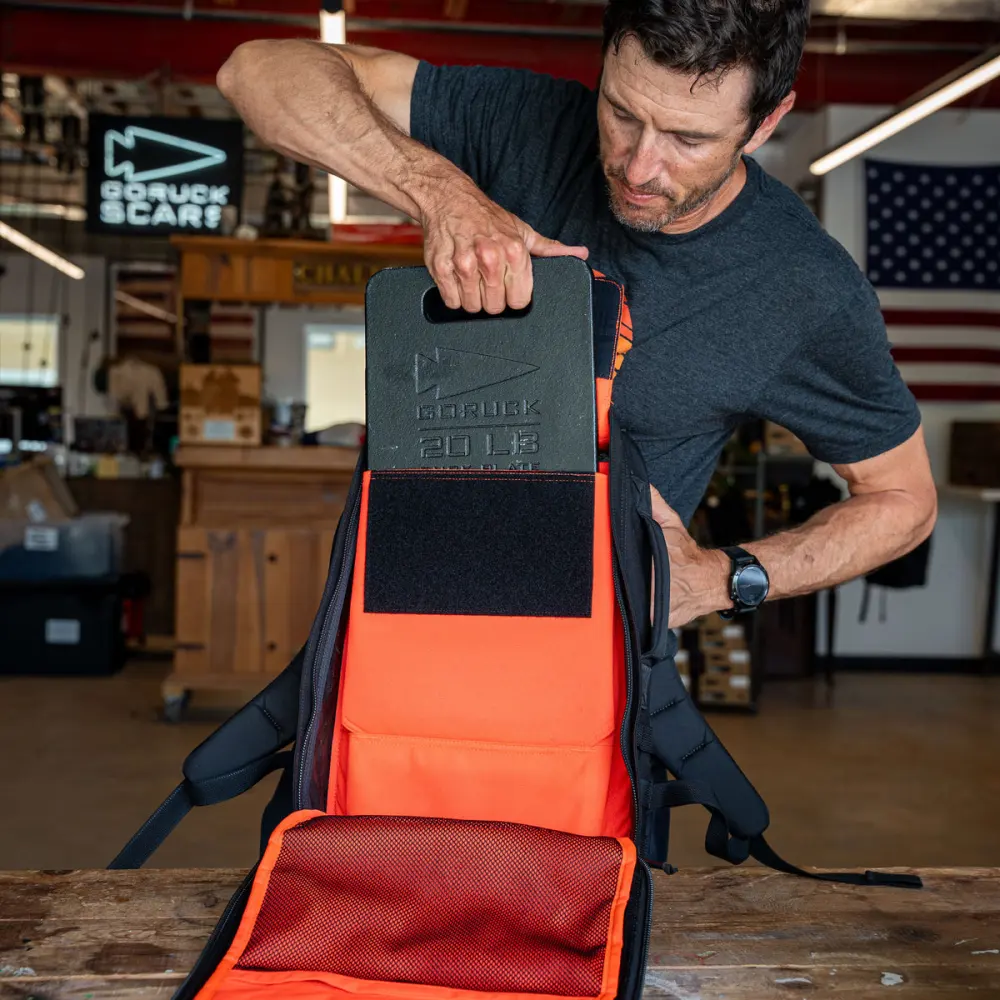
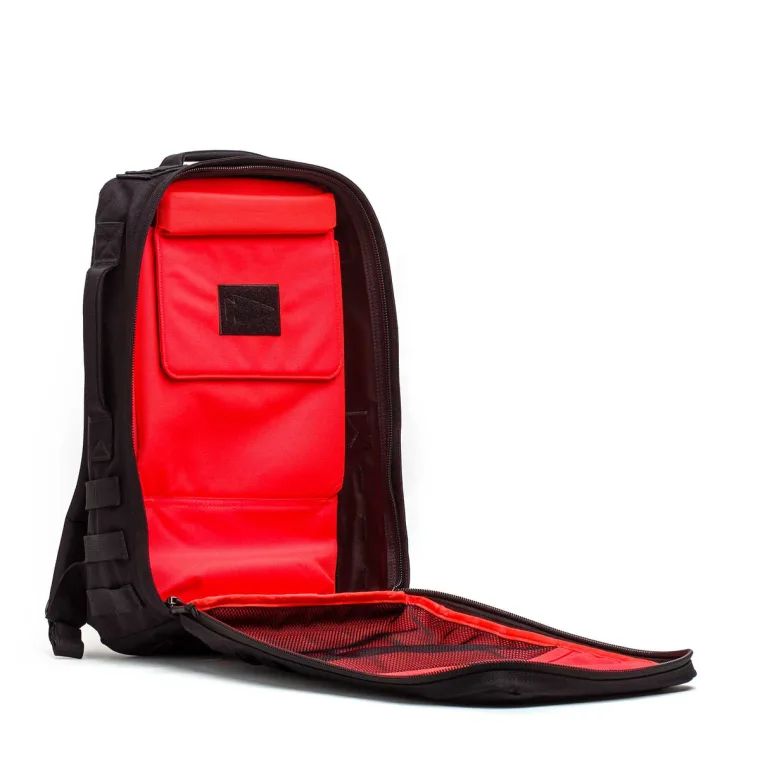
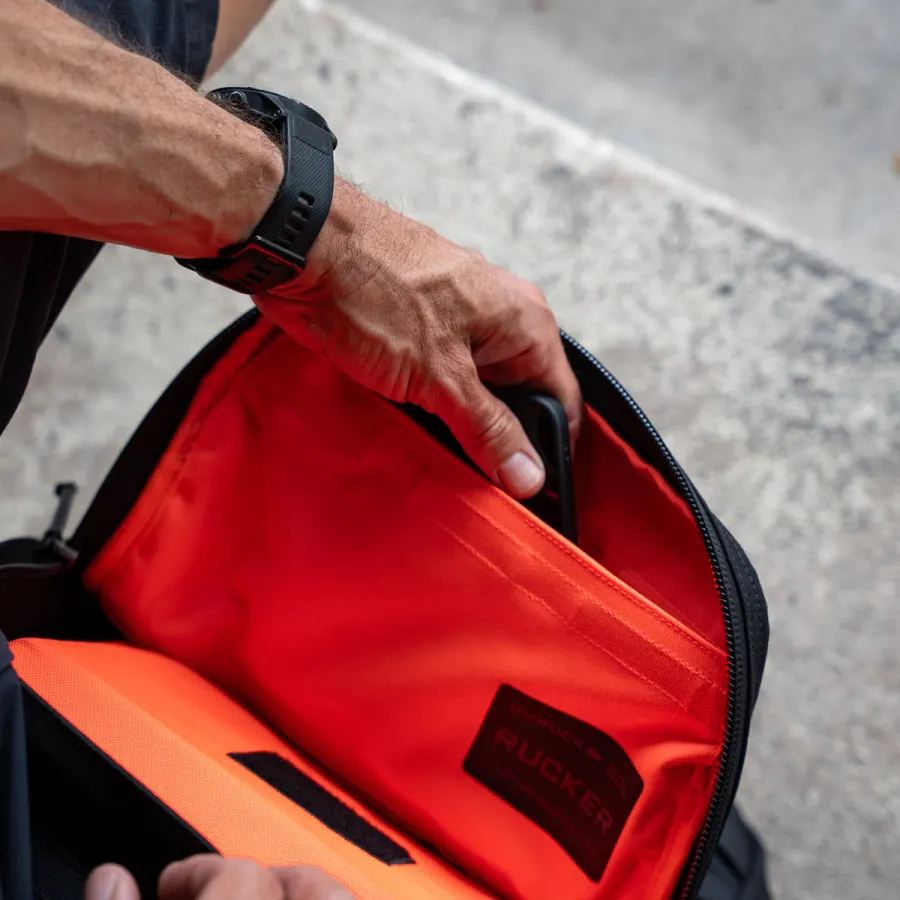
This is also the one thing a purpose built ruck buys you that a school bag cannot. The Rucker carries its weight in two elevated internal pockets rather than in the main compartment, so the plate cannot slide down to the base of your back or shift around while you walk. GORUCK describes those pockets as dual elevated pockets that secure the weight exactly where it belongs.
Their own customers describe the effect in almost mechanical terms, without being asked about posture:
★★★★★
This 25L bag places weights exactly where they need to be for good posture and excellent mobility on my 6'3" frame, leaving me free to pursue my workout without discomfort from a poor fit or unnatural load on the body.
JEFF W. · July 8, 2026Verified buyer
★★★★★
The new thick pad at the base of the pack encourages an upright posture when walking.
David Z. · June 10, 2026Verified buyer
★★★★★
The weight rides up high, so it does not pound the lower back. And with proper road marching technique there is no pain in the joints.
John G. · July 26, 2026Verified buyer
Reviews published on the Rucker product page at goruck.com. Read in full, with the rest, there.
06 The arithmeticWhy the fix is a walk and not a gym program
If the goal were only posture, a physical therapist could give you a program. The reason rucking keeps coming up instead is that it is the version of the fix you will actually still be doing in March, and the numbers on GORUCK's own benefits page explain why.
Start with the one that decides whether a habit survives. Walking with weight is not a different activity from walking. It is the same activity with the dial turned up.
Calories, same 30 minute walk
An average person on a half hour walk, with and without a loaded pack.
Figures published by GORUCK, citing the Compendium of Physical Activities: about 125 calories walking, about 325 rucking, depending on load and pace. Two to three times the burn for the same half hour outside.
Now the one that decides whether your knees let you keep going. GORUCK cites a study measuring ground reaction force at the knee: running lands about 8 times bodyweight per foot strike, walking about 2.7 times. Because rucking keeps the walking gait, it stays at 2.7 times, applied to you plus the pack.
Force per foot strike, a 150 pound person
GORUCK's worked example, using a 30 pound load.
Running multiplies bodyweight by roughly 8 at every strike. Rucking keeps the walking multiplier of about 2.7 and applies it to bodyweight plus load. Multiplied across tens of thousands of strides, that gap is the whole reason this is sustainable.
And the one that decides whether you are still doing it in twelve months. GORUCK points to a US Army study that tracked injuries in the 101st Airborne Division over a year. Running caused 34 percent of the division's injuries. Rucking caused 2 percent.
Injury shares over one year in the 101st Airborne Division, as reported by GORUCK on Physical Benefits of Rucking.
Their founder's summary of the appeal is shorter than any of this. Rucking, Jason McCarthy told the writer Michael Easter on a walk into the company's headquarters, is cardio for people who hate to run, and lifting for people who hate the gym.
What this does not do
Three things worth saying plainly, and GORUCK says the first of them themselves, which is not a common thing for a company to publish next to a product.
- There is no definitive study on heavy military rucking and the back. Their words: there is no definitive study out there detailing the long term or even short term effects of military rucking on your back, and excessive loads, 125 pounds and the like, are not to be replicated. The case being made is for light to moderate loads, not for the extremes.
- It is not a treatment. If you have a diagnosed disc problem, active nerve pain or a spine injury, this is a conversation with your doctor before it is a purchase.
- It will not undo ten years in one month. The mechanism here is hours under a corrective load, accumulated. That is the same currency the problem was built in.
What is left after those three caveats is still unusually good odds for a fitness claim: a low impact walk that keeps your shoulders back while you do it, backed by the brand's own citations rather than by vibes.
08 The starting protocolThe first month, from their own three steps
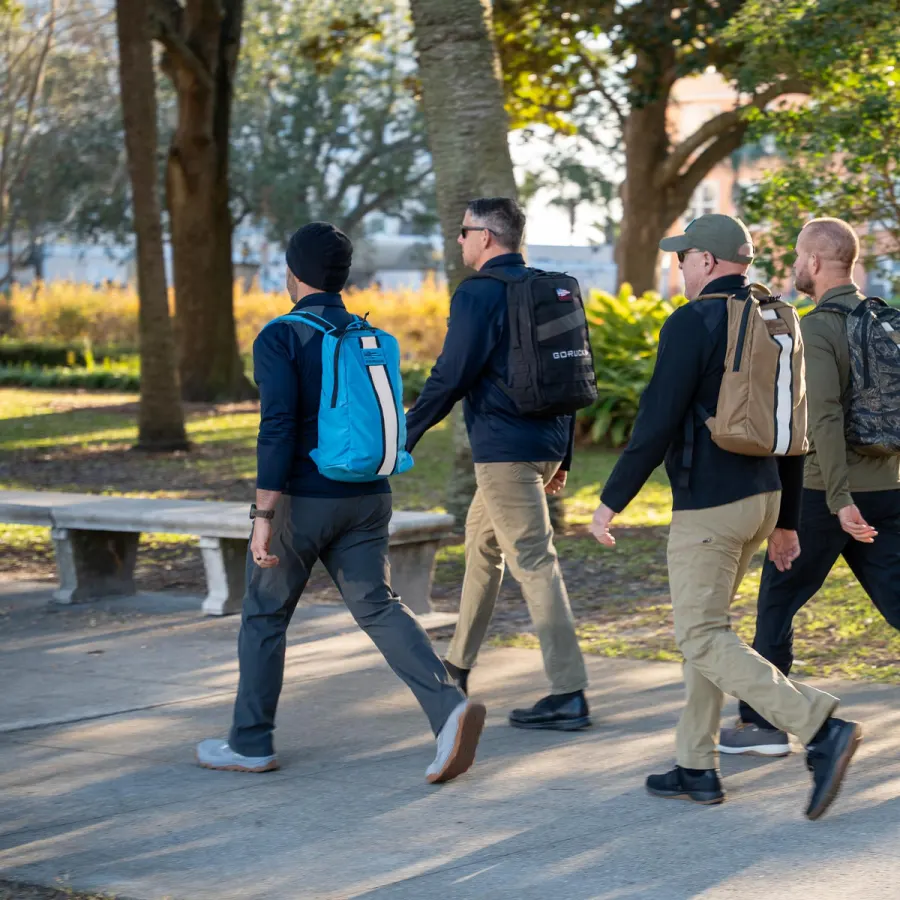
GORUCK's beginner guide is three instructions long. Get a ruck, and any backpack works to begin with. Add weight, and when in doubt start with 10 to 20 pounds. Then just walk, at a comfortable pace, keeping an upright posture, increasing weight, speed and distance over time.
That is genuinely all of it. Laid out on a calendar, a first month that respects the progression rule looks like this.
| Week | Load | Walk | Watch for |
|---|---|---|---|
| 1 | 10 lb | 20 to 30 min, 3x | Strap tension |
| 2 | 10 to 20 lb | 30 to 40 min, 3x | Shoulders staying back |
| 3 | 20 lb | 40 to 50 min, 3x | Add hills |
| 4 | 20 to 30 lb | One longer walk | Has it stopped feeling like a workout |
A straightforward reading of the three steps and the progression rule published in GORUCK's Get Started Rucking guide. Week 3 is the progression Dr. McGill describes: walk, then walk up a hill, then add load. Not an official GORUCK training plan. Their calorie calculator will tell you what any given version of it burns.
The two rules that matter more than the schedule
- Weight high, against your back. Not in the bottom of the bag. This is the difference between the effect described on this page and a sore lower back.
- Straps cinched down. A loose pack swings, and a swinging load pulls your shoulders forward with every step, which is the exact position you are trying to get out of.
Any backpack works. Here is what changes when it is built for this.
Worth repeating, because it is GORUCK's own position and it is the opposite of what you would expect them to say: any backpack works, and you should not overthink it. Grab whatever is in the closet, put something heavy in it, go for a walk. If you never buy anything, the mechanism still works.
People generally upgrade for one of two reasons. Either the school bag started hurting somewhere, or they realised they were going to keep doing this. Both show up constantly in the reviews.
★★★★★
I was using a regular backpack filled with 2 dumbbells and a couple small plates to see if I enjoyed the experience of rucking. First time out with the Rucker was amazing. It carries really well and everything feels very sturdy.
Trey M. · January 9, 2024Verified buyer
★★★★★
Eliminated my back pain. Now I feel the load in my legs and my traps. For anyone rucking with plates, it is absolutely worth the money.
Rebecca K. · July 23, 2026Verified buyer
★★★★★
Very sturdy. I just got into rucking and glad I made this purchase. Much better on my back than the regular backpack I was trying to use.
Melinda B. · December 15, 2025Verified buyer
A backpack
Weight sits low
The plate settles to the bottom of the main compartment, away from the spine, and moves as you walk.
Built for rucking
Weight sits high
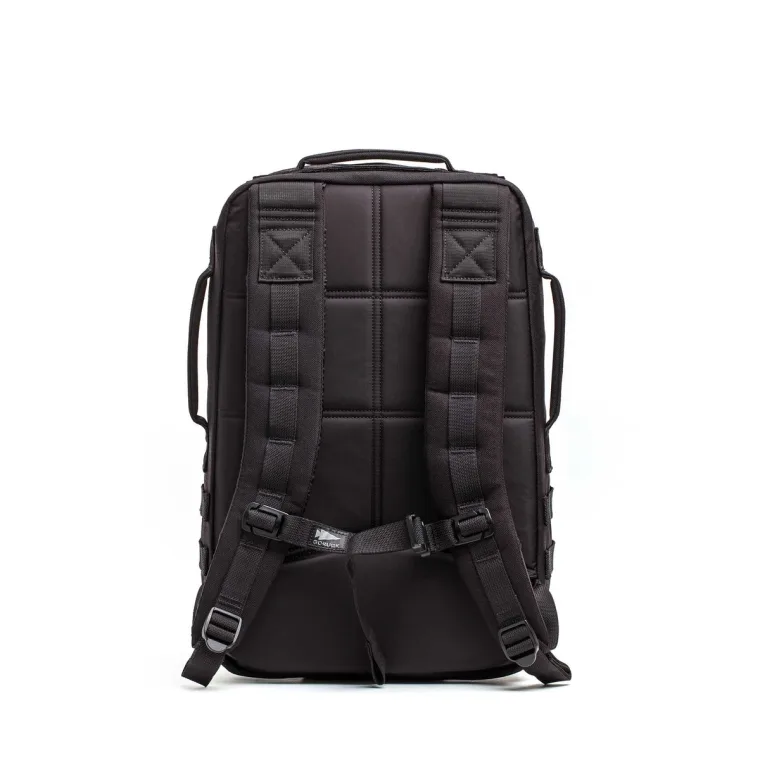
Two elevated pockets on the back panel hold the plate against the upper back and stop it sliding.
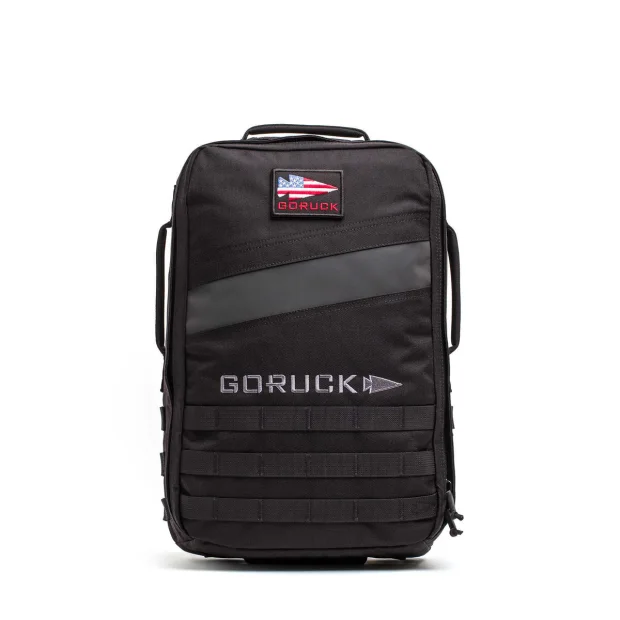
Rucker 5.0
20L and 25L · rated 4.8 out of 5 across 4,688 reviews
$265 plus plates from $59
- Two elevated ruck plate pockets. A short pocket for 10, 20 or 30 pound standard plates, a long pocket for 30 or 45 pound long plates, up to 75 pounds using both.
- 30 mm high density EVA lumbar pad. The change GORUCK highlights for the 5.0, and the part reviewers keep naming when they mention upright posture.
- Built in frame sheet. Holds the shape of the pack as you weigh it down, so the load stays where you put it.
- 1000D Cordura, 210D high tenacity back panel. Opens flat, four padded handles, YKK zippers, rainproof.
- Scars Lifetime Guarantee. Break it and they repair or replace it, no proof of purchase, no time limit. Full price items return free within 30 days in the USA.
If you already own a pack you like, the cheaper move is to skip the ruck entirely and buy the weight. A flat plate against your back beats loose dumbbells for the same reason everything above says: it does not move.
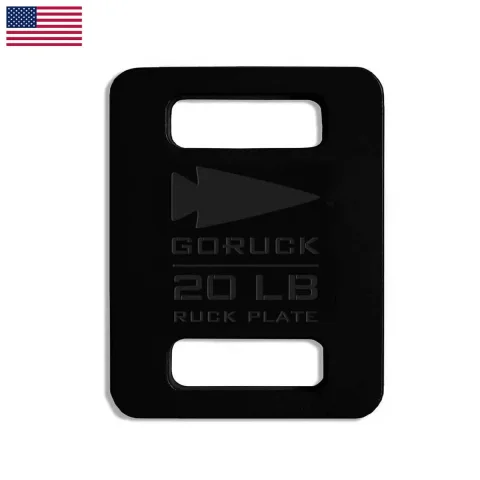
Ruck Plates
The cheapest way to start, in the bag you already own
$59 10 lb · $79 for 20 lb · $89 for 30 lb
Before you put weight in a bag
How much weight should I actually start with?
GORUCK's guide says when in doubt, 10 to 20 pounds. Starting heavier is the most common way to end the experiment in week one.
Will this hurt my back?
Carried low and loose, it can. Carried high and cinched, GORUCK's position, supported by the studies they cite, is that light to moderate loads let the spinal muscles rest rather than strain. If you have an existing back diagnosis, ask your doctor first.
Do I need special shoes?
No. It is a walk. GORUCK sells rucking shoes and boots, and plenty of people ruck in trainers for years first.
How fast does posture actually change?
Nobody honest will give you a date. What changes immediately is the position you are in while you walk. Everything after that is a question of how many hours you accumulate in it.
Is 20 pounds enough to do anything?
For the postural effect, the load only has to be enough to pull your shoulders back and stay there. For the metabolic side, GORUCK's own figures put a loaded half hour walk at roughly two to three times the calories of the same unloaded walk.
The short version
Your phone did not break your posture. Hours did, and they are still accumulating, on the side of your body where every load in modern life happens to sit. The correction is not a stretch you will forget by Thursday. It is a few hours a week where the weight is behind you instead of in front of you, high on your back, tight against your spine, while you do the most ordinary thing there is.
Start with the Rucker 5.0 Or put a $59 plate in the bag you already own